2-Year Warranty
 200+ Local Dealers
 UL&CE Certified
2-Year Warranty
200+ Local Dealers
UL&CE Certified
2-Year Warranty
200+ Local Dealers
UL&CE Certified
2-Year Warranty
200+ Local Dealers
UL&CE Certified
2-Year Warranty
200+ Local Dealers
UL&CE Certified
2-Year Warranty
200+ Local Dealers
UL&CE Certified
2-Year Warranty
200+ Local Dealers
UL&CE Certified
2-Year Warranty
200+ Local Dealers
UL&CE Certified
UL&CE Certified
2-Year Warranty
200+ Local Dealers
UL&CE Certified
2-Year Warranty
200+ Local Dealers
UL&CE Certified
2-Year Warranty
200+ Local Dealers
UL&CE Certified
2-Year Warranty
200+ Local Dealers
UL&CE Certified
2-Year Warranty
200+ Local Dealers
UL&CE Certified
2-Year Warranty
200+ Local Dealers
UL&CE Certified
2-Year Warranty
200+ Local Dealers
UL&CE Certified
 30-Day Return
200+ Local Dealers
UL&CE Certified
30-Day Return
200+ Local Dealers
UL&CE Certified
30-Day Return
200+ Local Dealers
UL&CE Certified
30-Day Return
200+ Local Dealers
UL&CE Certified



 2-Year
Warranty
200+
Local Dealers
UL&CE
Certified
2-Year
Warranty
200+
Local Dealers
UL&CE
Certified
2-Year
Warranty
200+
Local Dealers
UL&CE
Certified
2-Year
Warranty
200+
Local Dealers
UL&CE
Certified
2-Year
Warranty
200+
Local Dealers
UL&CE
Certified
2-Year
Warranty
200+
Local Dealers
UL&CE
Certified
2-Year
Warranty
200+
Local Dealers
UL&CE
Certified
30-Day Return
200+
Local Dealers
UL&CE
Certified
30-Day Return
200+
Local Dealers
UL&CE
Certified
2-Year
Warranty
200+
Local Dealers
UL&CE
Certified
2-Year
Warranty
200+
Local Dealers
UL&CE
Certified
2-Year
Warranty
200+
Local Dealers
UL&CE
Certified
2-Year
Warranty
200+
Local Dealers
UL&CE
Certified
2-Year
Warranty
200+
Local Dealers
UL&CE
Certified
2-Year
Warranty
200+
Local Dealers
UL&CE
Certified
2-Year
Warranty
200+
Local Dealers
UL&CE
Certified
30-Day Return
200+
Local Dealers
UL&CE
Certified
30-Day Return
200+
Local Dealers
UL&CE
Certified


Be the first to hear about exclusive offers and the newest ebikes.
By signing up, you agree to receive marketing emails. You can unsubscribe at any time. By submitting your email, you also agree to our privacy policy and terms. Contact EMMO at 1224 Dundas Street E, Unit 6, Mississauga, ON L4Y 2C5.
*Good for ebike purchases only.
Electric bike batteries are high-energy components that require proper use, charging, storage, and maintenance.
This page provides important safety information to help reduce risks, extend battery life, and ensure safe operation.
By using this product, users acknowledge their responsibility to follow the safety instructions outlined below.
• Always follow the brand’s instructions for battery use, charging, storage, and maintenance.
• Use only original or brand-approved batteries, chargers, and accessories.
• Never modify, disassemble, or attempt to repair the battery or charger.
• Treat the battery as an electrical device — improper use may result in damage, injury, or fire.
Proper charging habits are critical for battery safety.
Charging Environment
• Charge only indoors, in a cool, dry, and well-ventilated area.
• Place the charger on a non-flammable surface such as concrete or brick.
• Keep the charging area clear of flammable materials, liquids, and clutter.
• Use a dedicated 110V wall outlet.
• Do not use extension cords, power strips, surge protectors, or shared outlets.
• Ensure the outlet and plug are clean, dry, and undamaged.
• Never leave the battery charging unattended.
• Charging should always be monitored to reduce safety risks.
• Disconnect the charger promptly once charging is complete.
• For safety, charging should not exceed 12 hours, regardless of battery level.
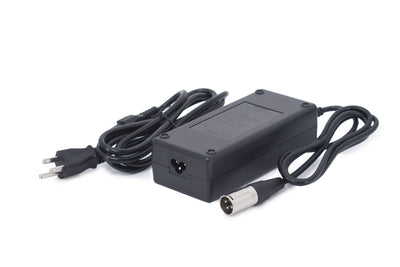
• Use only the charger supplied with the product or approved by the brand.
• Using third-party or incompatible chargers may cause overheating, malfunction, or fire.
• Do not use chargers with damaged cords, plugs, connectors, or housings.
Charging and storing batteries outside approved temperature ranges increases safety risks.
• Do not charge or store the battery outside the recommended temperature range.
• Recommended charging temperature: 0°C – 45°C (32°F – 113°F).
• Allow cold batteries to warm to room temperature before charging.
• Do not expose the battery to heaters or extreme heat sources.
• Do not drop, strike, crush, puncture, or expose the battery or charger to physical shock.
• Do not place heavy objects on the battery or charger.
• Avoid vibration, impact, or rough handling during transport and use.
• If the battery has been dropped, impacted, or shows visible damage, discontinue use immediately.
• The battery is designed for normal outdoor use, including riding in light rain or snow.
• Do not charge the battery while it is wet or damp.
• If the battery has been exposed to excessive moisture, immersion, or water ingress, stop use immediately.
• Allow the battery to dry completely before charging.
• Contact customer support if abnormal behavior is observed.
Immediately stop using and charging the battery if you notice:
• Unusual heat during charging or use
• Smoke, sparks, or burning odor
• Swelling, deformation, leakage, or discoloration
• Unusual noises or electrical malfunction
Disconnect power and move the battery to a safe, non-flammable area if possible.
Contact customer support for further instructions.
If the battery will not be used for an extended period:
• Store the battery in a cool, dry location away from flammable materials.
• Maintain a charge level of approximately 75% for long-term storage.
• Check the battery at least once per month and recharge if necessary using the original charger.
• Do not store batteries in vehicles or unregulated environments.
Battery fires are rare but require special handling.
• Never use water on a lithium-ion battery fire.
• Use sand or a fire extinguisher rated for lithium-ion fires if available.
• Evacuate the area and contact emergency services immediately.
• Battery and charger components have a limited service life and should be replaced if they show signs of aging, damage, or abnormal performance.
• Continued use of worn or damaged components increases safety risks.
• Proper care may help extend usable life, but service life cannot be guaranteed.
• Users are responsible for proper use, charging, storage, and maintenance of the battery.
• Failure to follow safety instructions may result in unsafe conditions, damage, injury, or fire.
• Improper use, unsafe charging practices, unauthorized modification, or use of non-approved equipment may void warranty coverage.
If you have questions about battery safety or notice any abnormal behavior, please contact us before continuing use
Toll-Free: 1-888-217-1217
Email: service@emmo.ca